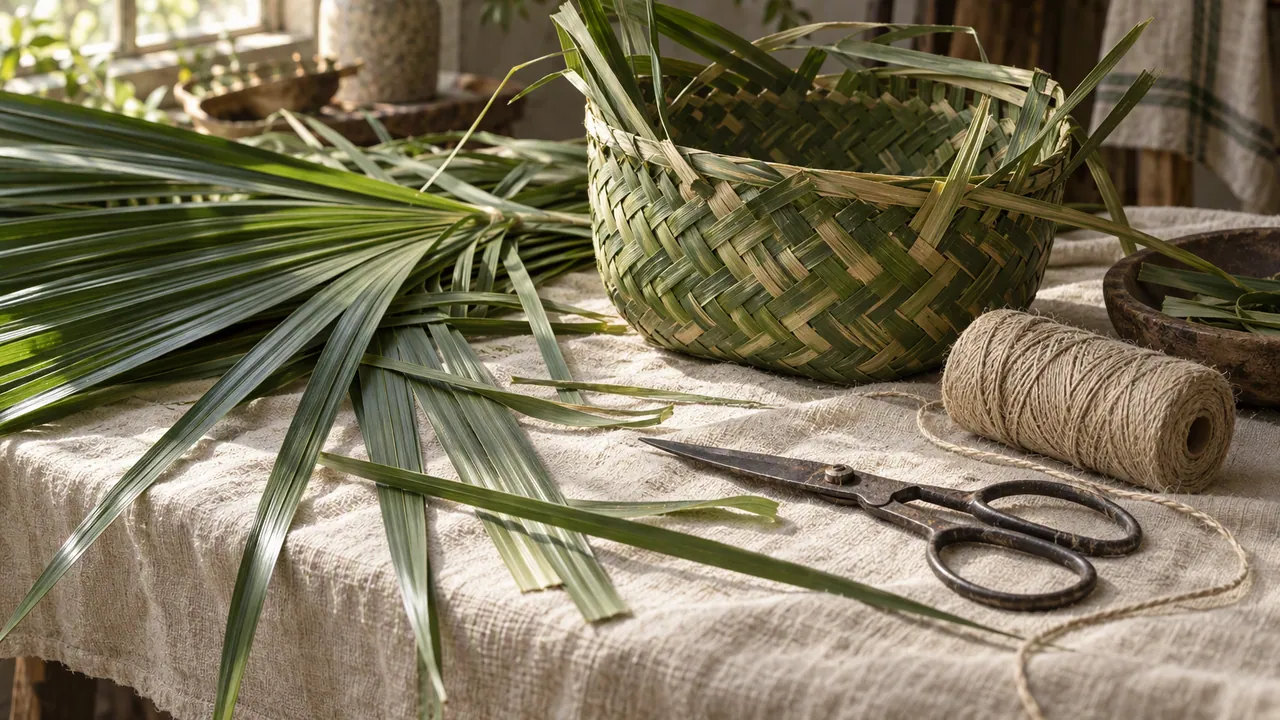
Weaving has a vocabulary that is centuries old and, in places, genuinely confusing — partly because different regions use different words for the same thing. This is the glossary we use consistently across every tutorial on this site.
Materials
| Term | What it means |
|---|---|
| Spine | The stiff central rib running down the length of a palm leaf. Usually removed before weaving because it does not bend. |
| Leaflet | One of the narrow blades attached to the spine. Most weaving uses the leaflets, not the whole leaf. |
| Strip | A leaflet that has been split to a consistent width, typically 5 to 12 mm, ready for weaving. |
| Softening | Soaking or steaming strips so they bend without cracking. Fresh leaves need minutes; dried leaves need hours. |
| Sizing | Sorting strips by width and thickness so a single piece uses consistent material. |
| Curing | Letting a finished piece dry slowly in the shade so it holds its shape without becoming brittle. |
Weaving structure
| Term | What it means |
|---|---|
| Warp | The strips that stand upright and form the skeleton of the piece. |
| Weft | The strips woven horizontally through the warp. Also called the weaver. |
| Over-under weave | The basic pattern: each weft passes alternately over and under each warp. Also called plain weave. |
| Twill | A weave where the weft passes over two warps and under one, producing a diagonal pattern. |
| Tension | How tightly the weft is pulled. Even tension is the single biggest factor in whether a basket stays square. |
| Slope | The natural outward flare of a basket wall. A controlled slope keeps the rim wide and the base stable. |
Finishing
| Term | What it means |
|---|---|
| Rim lock | The final row, folded over the row below and tucked in, which stops the whole piece unravelling. |
| Tucking | Pushing a loose strip end back into the weave so it is hidden and held. |
| Paring | Trimming a tucked end flush so it does not snag. |
| Lashing | Binding a rim or handle with a separate cord for extra strength. |
| Handle wrap | Winding cord or soft leaf around a handle to make it comfortable to hold. |
One term, two meanings: in the United States "weaver" usually means the horizontal strip, while in parts of Asia it refers to the person doing the weaving. We use it only for the strip.
Put the vocabulary to work
The beginner guide walks through every one of these terms in practice.