
In short
A styling guide, not a tutorial: where to place woven baskets, what size to choose for each room, and the two rules that stop them looking cluttered.
Most people own a woven basket and still feel their room looks unfinished. The problem is rarely the basket; it is that baskets are treated as storage rather than as design. This is a styling guide, so there is no weaving here, just the placement and sizing decisions that make natural pieces look intentional.
Two rules do most of the work. First, a basket should be large enough to look deliberate in the space it occupies. Second, baskets work in odd-numbered groups of different sizes, never as a matching set. Everything below follows from those two ideas.
The reason a lone small basket disappears is scale. A 20 cm basket on a wide shelf or beside a deep sofa reads as clutter, while the same basket on a narrow windowsill looks considered. Before you buy or place anything, measure the surface it will sit on and aim for a basket that fills roughly a third of that width. That single proportion fixes more styling problems than any other change.
The two rules that matter most
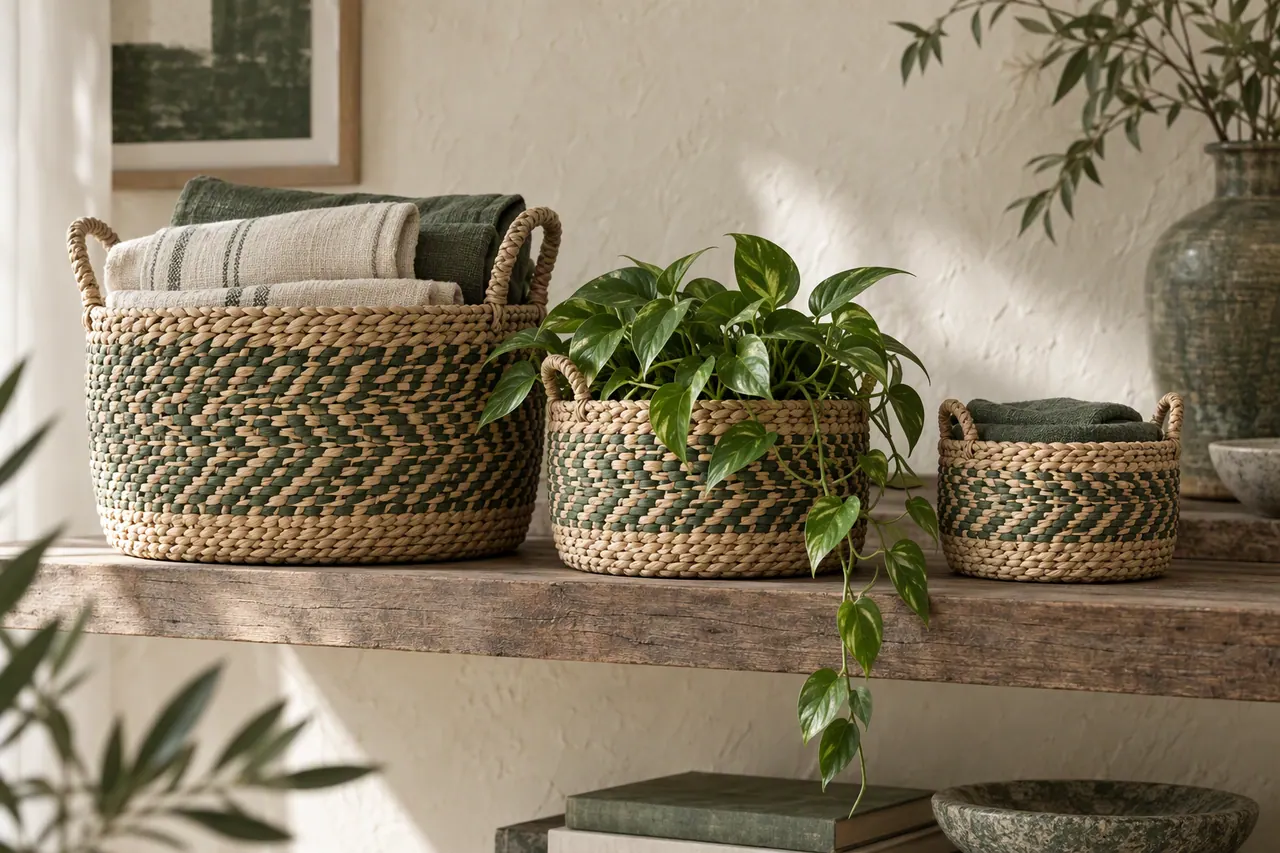
Rule one is scale: choose a basket that fills about a third of the surface it sits on. Rule two is grouping: arrange three baskets of different heights, in odd numbers, rather than two identical ones. A pair looks like a mistake; a trio looks styled. Keep the tallest in the middle or at one end, never dead centre in a symmetrical row.
- Fill about a third of the surface with the largest basket.
- Group in odd numbers, three is easiest.
- Vary the heights by at least 8 cm between pieces.
- Leave one basket empty so the group can breathe.
- Keep the colour of the group within one family: natural, honey or deep brown.
Which size for which room
Sizes are not interchangeable between rooms, because the scale of the furniture changes. A basket that looks generous in a hallway looks tiny next to a sofa. The table below is the sizing I use and recommend, measured across the widest point of the basket.
| Room | Ideal size | Best use |
|---|---|---|
| Living room | 40 to 50 cm | Blankets beside the sofa |
| Bedroom | 30 to 40 cm | Laundry or spare throws |
| Kitchen | 25 to 30 cm | Bread, fruit or utensils |
| Bathroom | 20 to 25 cm | Rolled towels or toiletries |
| Hallway | 45 to 55 cm | Shoes, bags and umbrellas |
| Shelf or console | 18 to 22 cm | Grouped as a trio with plants |
Placement ideas that always work
Some placements are dependable because they answer a real need rather than decorating for its own sake. A basket beside the sofa catches blankets; one by the door catches shoes. When a basket has a job, it never looks like clutter, and that is the whole secret of styling with natural pieces.
Try a large floor basket with a rolled throw and one flat cushion on top, a medium basket on a shelf holding a plant, and a small one on a side table for the television remotes. Three rooms, three jobs, one material, and the whole home feels more settled.
Helpful Tips
- Keep the largest basket on the floor, never on a shelf, unless it is under 25 cm.
- Put a rolled textile in at least one basket so it reads as intended, not empty.
- Line a kitchen basket with a linen cloth to stop crumbs falling through the weave.
- Rotate the baskets between rooms each season so the styling feels fresh without buying anything.
Find the right size for your room
Our woven collection lists exact dimensions for every basket, so you can match the guide above.