
In short
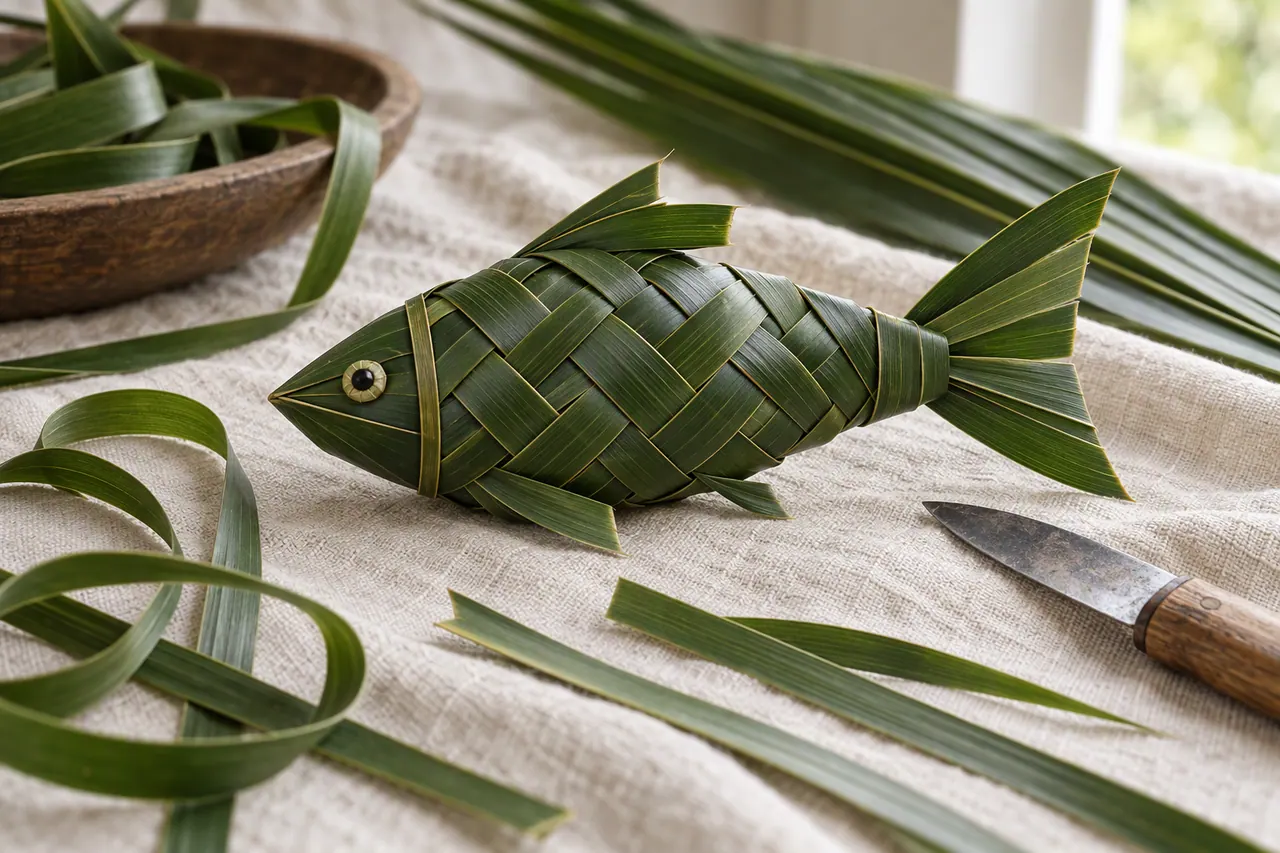
The woven coconut leaf fish is a traditional favourite, made from two leaflets in half an hour. Learn the fold, the tail, and the fins that bring it to life.
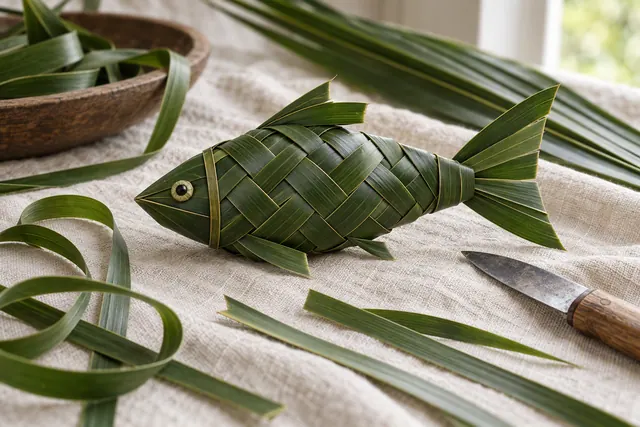
The fish is the figure I make most often, because it works at any size. Fold it small for a child to carry around, or large for a table centrepiece, and the same six folds do the job.
It is a traditional shape across much of South and Southeast Asia, and every maker I have met folds the tail a little differently. Here is the version I teach, with the measurements I actually use.
A leaf fish needs two leaflets and about thirty minutes. The body is a simple braid, the tail is a fan, and the fins are nothing more than two split strips eased outward. What makes it convincing is proportion: a fish that is roughly three times as long as it is deep looks right, while a short fat one looks like a leaf that got lost.
The leaf you want
Pick a leaflet that is broad and still green, about 4 cm wide at its widest. A narrow leaflet gives a thin, mean-looking fish, and an old one cracks at the tail. If you are folding a large fish, use two matching leaflets from the same frond so the colour and stiffness are consistent across both sides of the body.
What You'll Need
- 2 coconut leaflets, about 50 cm long and 4 cm wide
- Sharp scissors
- A damp cloth
- A ruler for the first few fish
Folding the fish
-
1
Cross the leaflets
Lay the two leaflets across each other at their centres so they form a neat cross. Press the crossing point flat.
-
2
Weave the body
Fold each arm of the cross over the next in turn, working around the centre, until you have a small square knot about 5 cm across.
-
3
Extend the body
Continue the same over-and-under weave outward along one axis for about 12 cm to form the body of the fish.
-
4
Shape the head
At the front, fold the loose ends inward and tuck them under the last row to round off the head. Trim to a blunt point.
-
5
Fan the tail
At the back, split the remaining ends into four strips and fan them into a tail about 8 cm across. Crease each strip so it holds.
-
6
Add the fins
Split one strip on each side of the body and ease it outward to form a fin. Trim each fin to a soft triangle.
Getting the fish to look right
- Keep the body three times as long as it is deep or the fish looks stunted.
- Fan the tail last, once the body is tight, so you do not crush it while weaving.
- A damp cloth wiped over the fins helps them crease without cracking.
- Trim the fins with a single clean cut; ragged edges fray as the leaf dries.
Folds that transfer to other figures
The over-and-under weave you use for the body is the same one that starts a basket base, and the tail fan is the same technique as the grasshopper legs. Learn the fish and you have quietly learned two of the most useful leaf folds there are. That is why I teach it early, even though the finished figure looks more advanced than the bird.
| Fish size | Leaflet length | Body length | Time |
|---|---|---|---|
| Small (ornament) | 35 cm | 8 cm | 20 min |
| Medium (gift) | 50 cm | 12 cm | 30 min |
| Large (centre piece) | 70 cm | 18 cm | 45 min |
Do not use leaflets that have already started to yellow. They look fine until you fold the tail, then split along the spine every time.
Prefer to buy one?
Our woven fish are made in small batches and finished by hand.