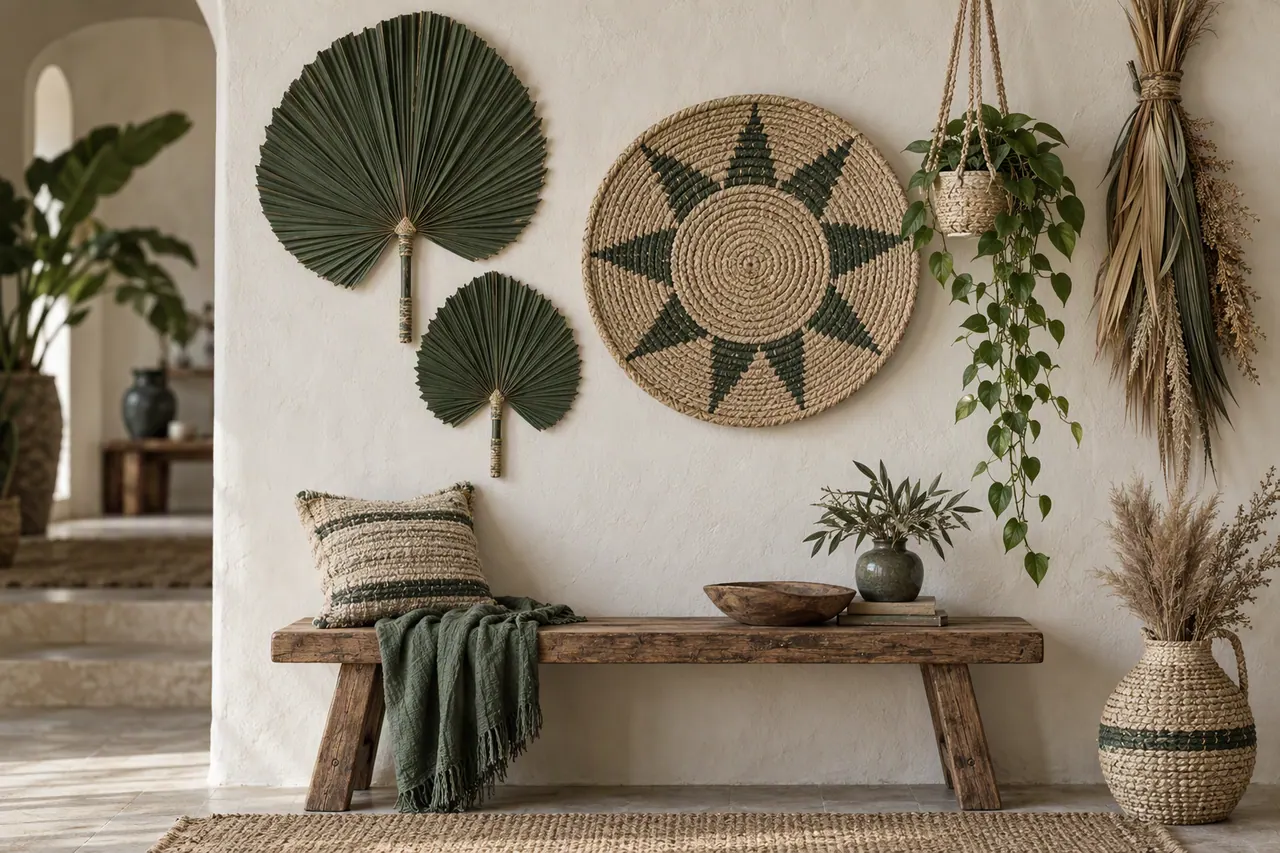

In short
A flat woven wall panel made from dried palm strips, a dowel and about two hours. Here is the honest version, including how to keep the panel from curling.
Most boho wall decor sold online is rope, driftwood and feathers. A woven leaf panel is the same idea with better materials: a flat over-under weave that shows off the natural grain of the leaf and costs almost nothing but time.
The version I make most is a rectangular panel about 30 cm wide and 45 cm tall, hung from a 40 cm dowel. It takes two hours and one skill, the over-under weave, which you will already have if you have made a single basket.
The one thing that ruins a leaf wall panel is curling. Fresh strips shrink as they dry, and if you weave them wet and then hang the panel straight away, the edges pull inward and the whole piece cups like a taco within a day. The fix is simple and non-negotiable: dry the finished panel flat under a board for a full night before you hang it.
Choosing and preparing the strips
Use dried palm strips rather than fresh ones for wall art. Dried strips hold a flatter, more graphic line, and they take a stain or a light wax beautifully. Cut them to a consistent 1.5 cm width and 55 cm length. You need about sixteen vertical strips and twelve horizontal ones to fill a 30 by 45 cm panel at a medium weave.
What You'll Need
- About 28 dried palm strips, 1.5 cm wide and 55 cm long
- A 40 cm wooden dowel, 1 cm thick
- Sharp scissors
- Cotton twine for the hanging cord
- A flat board and a weight for drying
- A peg or clip to hold the first row
Step-by-Step Instructions
-
1
Soak briefly
Soak the dried strips in warm water for just five minutes. You want them bendy, not sodden, because wet strips shrink more and curl harder later.
-
2
Lay the warp
Lay sixteen strips vertically across your work surface, spaced evenly, and tape the top ends down so they stay parallel and about 2 cm apart.
-
3
Weave the weft
Take a horizontal strip and weave it over one vertical, under the next, across the full width. Push it snug against the row above with your fingertip.
-
4
Alternate the rows
Start the next row with the opposite pattern, going under the strips the row above went over. Continue for twelve rows, keeping the weave square.
-
5
Secure the edges
Fold the outermost vertical strips over the side rows and tuck the ends back into the weave to lock the edges so they cannot slip.
-
6
Dry flat, then hang
Lay the panel flat under a board with a weight overnight. Then thread the dowel through the top row, tie the twine cord to both ends and hang it.
Layouts that actually look good
- One large panel centred over a low sofa, hung so the base sits about 25 cm above the cushions.
- A row of three small panels of different heights for a hallway.
- A single tall panel beside a floor lamp, which reads as sculpture rather than craft.
- A short wide panel above a bed headboard, kept under 40 cm tall so it does not crowd the pillows.
Helpful Tips
- Cut every strip to the same length; uneven ends are the most common giveaway of a homemade panel.
- Weave on a board you can move, so you never have to lift a half-finished panel.
- A thin coat of beeswax after drying deepens the colour and stops the strips absorbing dust.
- Hang away from a radiator; heat makes dried leaf brittle and it will crack at the edges.
Prefer it ready-made?
Our woven wall panels use the same dried-leaf weave and arrive already dried and sealed.