
In short
Everything that happens before the weaving: choosing leaves, stripping the spine, cutting even strips, softening dry leaf and storing what you do not use.
Almost every failed palm leaf project fails before the weaving starts. The leaf was too old, or the strips were cut unevenly, or the whole thing dried out on the table while the maker was still reading the instructions.
This is the reference I wish I had at the beginning. It covers choosing, stripping, cutting, softening and storing, in the order you actually do them.
There is a short window in the life of a palm leaf when it is perfect for weaving. Too fresh and it is limp and wet, and the weave will not hold tension. Too old and it cracks at every fold. The sweet spot is somewhere between two and twenty-four hours after cutting, when the leaf is cool and slightly leathery and bends without a sound. Learning to recognise that moment is worth more than any pattern, because no technique can rescue a leaf that has gone brittle. Read the section below on choosing leaves twice, and the rest of your palm leaf work will get easier immediately.
Choosing the right leaves
Not every palm leaf is worth weaving. Look for leaflets from the middle of a healthy frond: long, broad, and deep green without brown edges. Leaflets from the tip are short and thin, and leaflets from the base are often torn. If you are cutting from a garden palm, take the frond that has just opened but is still firm. Avoid anything on the ground, and avoid leaves with black spots, which usually means fungus that will spread through the weave as it dries. A good frond gives you twenty to thirty usable strips, which is enough for a small basket or a full set of coasters, so one careful choice saves a lot of wasted cutting.
| Leaf type | Feel | Best for | Verdict |
|---|---|---|---|
| Fresh, deep green | Cool, leathery, bends silently | All weaving | Ideal |
| Just cut, still wet | Limp, drips water | Waiting a few hours | Too soft |
| Older, pale green | Stiff, creaks at the fold | Nothing much | Too dry |
| Brown at the edges | Brittle at the tips | Compost | Discard |
Stripping and cutting
- Cut each leaflet cleanly from the central spine with scissors, close to the stem.
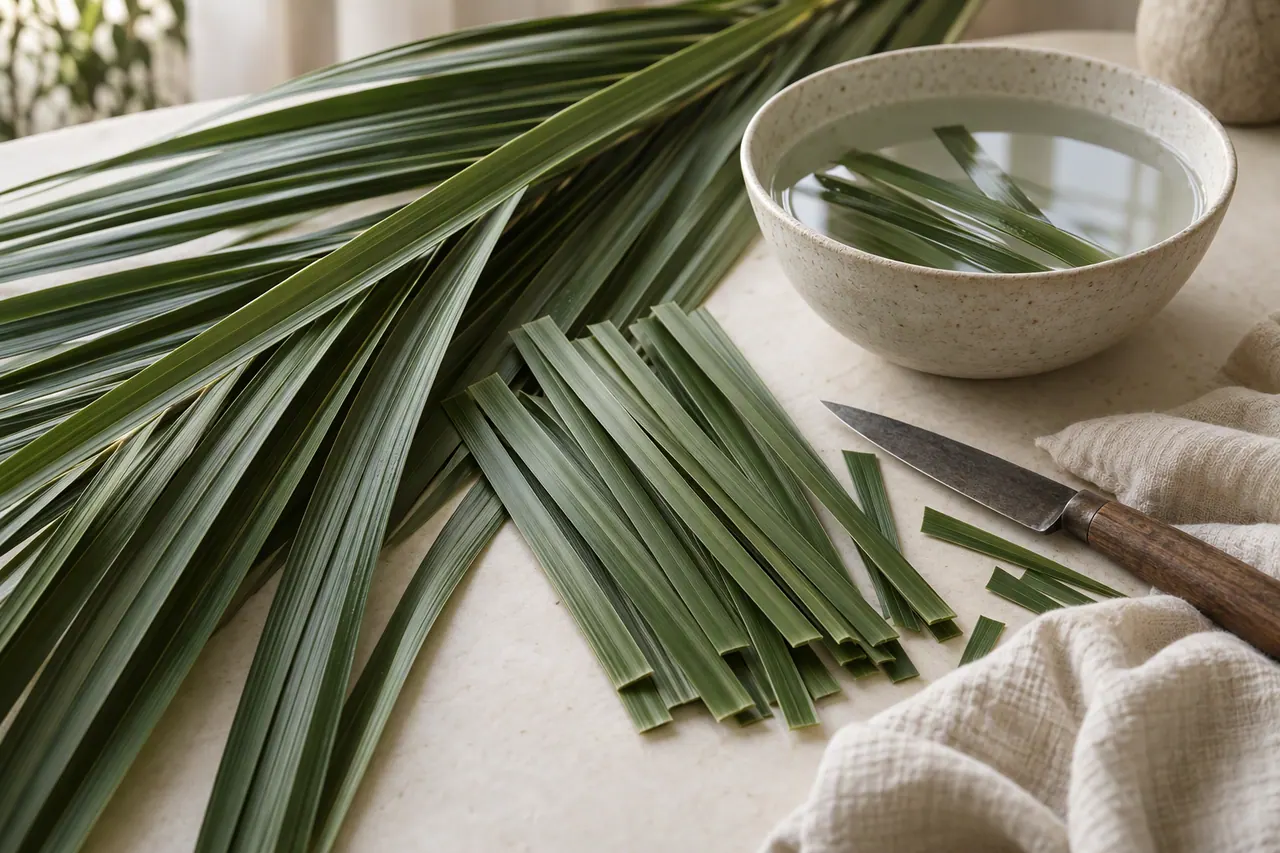
- Lay the leaflet flat and slice it into strips 1.5 to 2.5 cm wide, depending on the project.
- Pinch the tough midrib at the tip and pull it away in one steady motion.
- Trim the ends square so every strip starts and finishes at the same length.
- Rest the prepared strips under a damp cloth while you work through the rest.
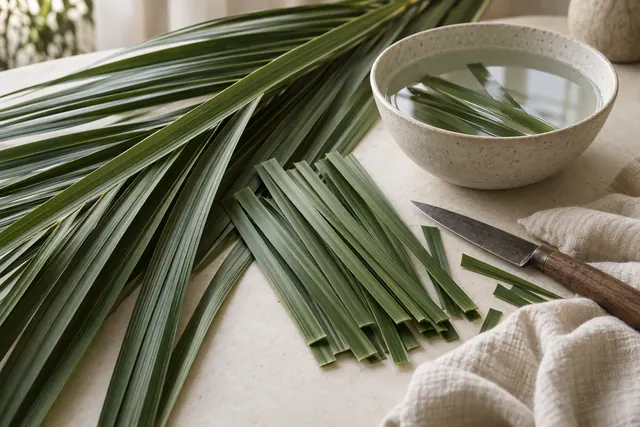
Strip width is the single biggest variable in how a project turns out. Thin strips of 1.5 cm give fine, delicate work: coasters, bookmarks, lampshades. Wide strips of 2.5 cm give sturdy, rustic pieces: baskets, trays, storage. Cutting wider than 3 cm makes the strip hard to fold and the weave bulky, so keep everything under that. Whatever width you choose, keep it consistent. Mixed widths in one project show up as a lumpy, uneven surface once it dries. If you are cutting by eye, measure the first five strips against a ruler until your hand learns the width, then check every tenth strip to stop yourself drifting.
Softening dry or stubborn leaves
Dry leaf is not ruined, just thirsty. Ten to fifteen minutes in cool water will bring most brittle strips back to a workable state.
- Soak brittle strips in cool water for 10-15 minutes, then blot them dry with a towel.
- For a quick fix on a single strip, mist it and wrap it in a damp cloth for five minutes.
- Never use hot water. It softens the leaf for a moment and then makes it mushy and weak.
- Wipe away surface water before weaving. Wet leaf slips and the weave will not hold.
- Re-damp as you go with a spray bottle, but keep the finished weave dry.
Storing prepared strips is where most people lose their work. A strip left out on a table will be unusable within an hour, and one left in a plastic bag will go mouldy by the next morning. The workable middle ground is a cloth bag or a lidded box with a damp cloth inside: cool, dark, and slightly humid. Stored that way, cut strips keep for about two days. Beyond that, dry them fully and re-soak them when you next want to weave. Never seal damp strips in a plastic bag, because trapped moisture is the one thing that turns a good batch of strips into a mouldy mess overnight. A simple test tells you whether a stored batch is still good: bend one strip into a loop. If it flexes without a sound, it is ready. If it creaks or cracks, soak the whole batch in cool water for ten minutes, blot it, and try again. Strips stored correctly will still be workable on the second day, which is why preparing a batch on Friday and weaving across the weekend is such a comfortable way to work.
Helpful Tips
- Cut leaves in the morning and weave in the afternoon. That timing hits the sweet spot almost every time.
- Keep a spray bottle at the table. A two-second mist mid-project saves an hour of re-cutting.
- Strip the midrib before cutting to width, not after. It is far easier on a whole leaflet.
- Label your storage with the date. Strips older than two days are unreliable and not worth the risk.
- If a strip cracks anyway, do not throw it out. Short pieces are perfect for small projects like coasters.
- Cut a few extra strips every time. Running short mid-project is the most common reason people rush.
Let us do the prep.
Our prepared palm leaf strip bundles are cut to width, softened and sealed, ready to weave on arrival.