
In short
A practical starting guide to sustainable crafting: choosing materials, avoiding the common greenwash traps, and the small habits that actually reduce waste.
Sustainable crafting is often sold as a shopping list: buy recycled paper, buy natural fibre, buy the green option. That misses the point. The most sustainable craft supplies are usually the ones you already have, and the most sustainable habit is making fewer things better.
This guide is the practical version, built around choices rather than purchases, and written for someone who wants to craft without turning every project into a lecture on the environment. There is no guilt in it, only a set of decisions that happen to be cheaper and lower-waste.
The word sustainable gets stretched until it means very little, so it helps to have a working definition. A craft is more sustainable when it uses materials that are renewable, locally available, minimally processed, long-lasting and compostable at the end. No material scores perfectly on all five. The trick is knowing which ones matter for the project in front of you, and being honest that a perfect option rarely exists. A material that is local but not compostable can still beat one that is compostable but flown in. The right answer usually depends on the specific project, not on a general rule. That is why this guide talks about trade-offs rather than a list of forbidden materials.
Choosing materials
| Material | Renewable | Local potential | Compostable | Watch out for |
|---|---|---|---|---|
| Palm and coconut leaves | Yes | High | Yes | Long transport, pesticide use |
| Cotton thread | Yes | Medium | Yes | Very high water use |
| Wool | Yes | Medium | Yes | Methane from sheep, dye runoff |
| Jute twine | Yes | Medium | Yes | Often shipped long distances |
| Recycled paper | Varies | Medium | Yes | Energy used in recycling |
| Recycled fabric | Varies | Medium | Yes | Energy in processing, dye runoff |
| Acrylic yarn | No | Low | No | Fossil-fuel based, sheds microfibres |
The best material is usually the one that already exists near you and does not need much processing to be useful. A leaf that grows down the road beats a perfect fibre flown in from another continent, even if the leaf is less uniform and harder to work. Convenience and sustainability pull in opposite directions more often than the marketing suggests. Knowing that is the first step to choosing well.
The greenwash traps
- Assuming natural means sustainable. Natural materials can still be water-hungry, heavily processed or shipped a long way from where you live.
- Buying new green supplies for every project instead of using what you already have in the cupboard.
- Choosing compostable packaging that ends up in a general bin, where it behaves much like anything else.
- Overlooking the energy in processing, which for some materials outweighs the benefit of the material itself.
- Assuming local is always better. A local material produced with heavy energy use can still lose to a shipped one that needs little processing.
- Treating one purchase as a lifestyle. A single bamboo item does not offset a cupboard full of disposables.
The most common trap is simply buying more. A craft room full of unused eco supplies has a larger footprint than a small box of tools used constantly. Use what you have before you buy anything new, and when you do buy, buy for a project you are actually going to finish. The greenest purchase is almost always the one you did not need to make. A shelf of unopened supplies is not a commitment to the planet; it is just a slower kind of waste. Spend an afternoon with what you own before you spend money on anything else.
Habits that actually reduce waste
- Plan the whole project before cutting, so offcuts are minimised and you are not left with a pile of unusable scraps.
- Save every usable offcut in a single box rather than binning them; small pieces are perfect for ornaments and test weaves.
- Repair and re-weave before replacing, which is usually quicker than making a new piece from scratch. A ten-minute repair beats a two-hour rebuild every time.
- Dye with food colouring or natural dyes rather than solvent stains, and do it outdoors where possible. The colours are softer, but they are far kinder to hands and drains.
- Compost finished pieces that have reached the end of their life, once any synthetic parts are removed.
- Borrow or share specialist tools instead of buying ones you will use once and then store for years. A tool library or a craft group is worth more than a cupboard of unused gadgets.
What good looks like
A sustainable crafter is not someone with the greenest supplies. It is someone who makes fewer, better objects, keeps them for years, repairs them, and composts them at the end. That is a habit, not a purchase, and it is available to anyone with a few leaves and some patience. It is also, conveniently, the cheapest way to craft. The habits cost nothing and, over a year, they save a surprising amount of money as well as material. None of them requires a special purchase or a change of hobby.
Start Here
- Use what you already own for your next three projects before buying anything new.
- Choose one local, renewable material and learn it well rather than dabbling in ten.
- Make one object you will genuinely use every week, so it earns its place. A useful ugly thing beats a beautiful useless one.
- Set up a repair habit before you need it, with a small box of spare strips and thread.
Start with a local material
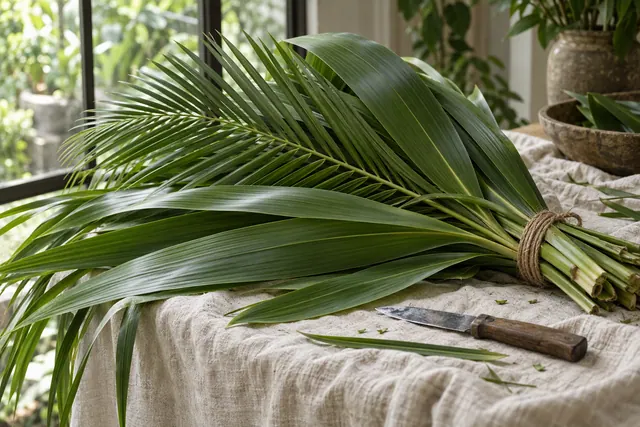
Our beginner kits use palm leaf, a renewable material you can also grow at home.