
In short
A factual look at how woven leaf crafts biodegrade, what speeds up or slows down composting, and why a coating or a synthetic thread changes everything.
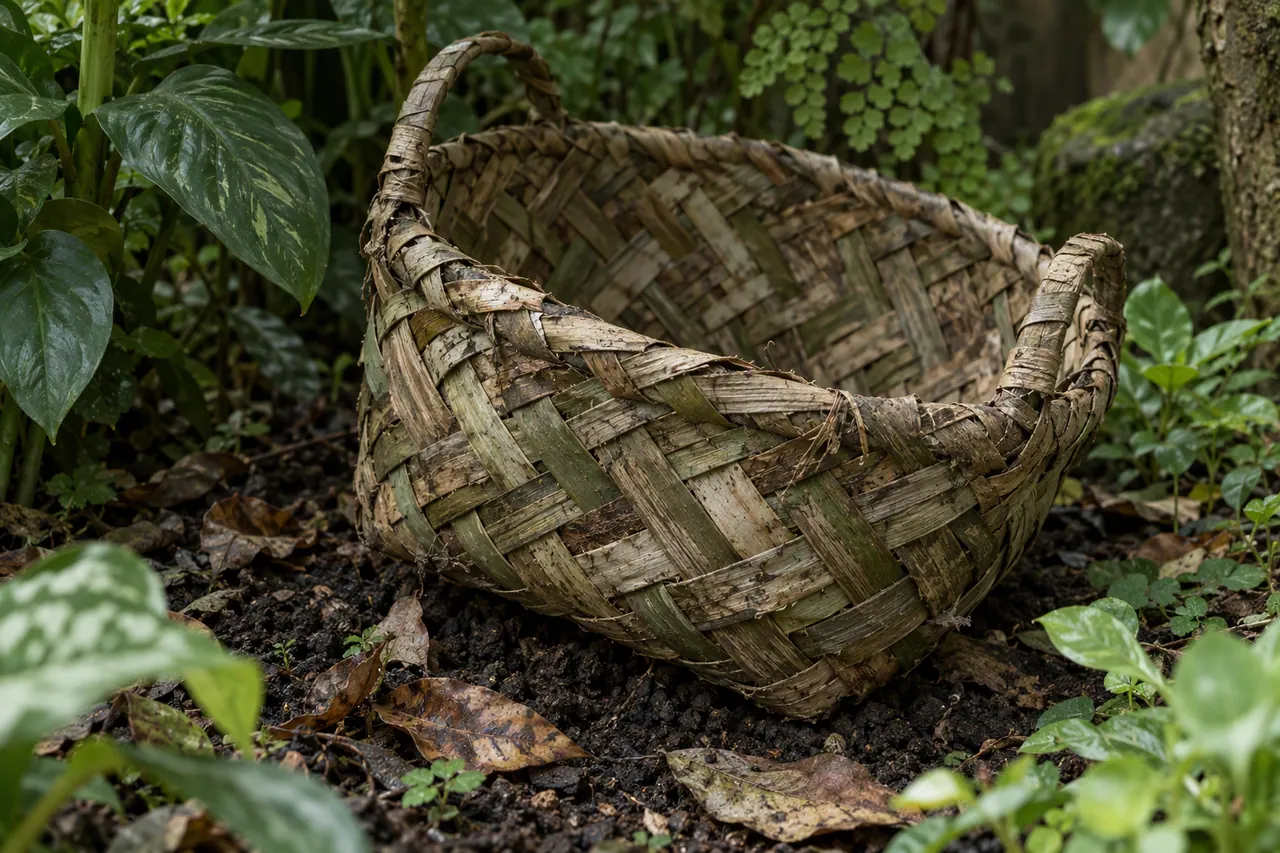
A woven leaf basket that has reached the end of its life can go into a compost heap and, within months, become something you spread on a garden bed. That is the promise, and it is broadly true, with important caveats that most cheerful articles leave out.
This is a factual explainer rather than an argument. It covers what actually happens to leaf crafts after composting, what slows the process down, and the one situation where the natural choice behaves worse than you would expect. None of it is an argument against leaf crafts; it is simply what the science says.
Biodegradation is simply the work of microorganisms breaking a material back into simpler compounds. For a leaf, this is easy because the plant built it from cellulose, hemicellulose and lignin, the same compounds a compost heap is already set up to digest. Given moisture, oxygen and warmth, a plain woven leaf will break down in roughly three to twelve months, depending on thickness and climate. The process is not mysterious; it is the same one that turns a fallen leaf into soil on a forest floor. The difference is only that a compost heap concentrates the conditions that make it happen quickly.
How long does it take?
| Material | Home compost | Industrial compost | Landfill |
|---|---|---|---|
| Thin palm leaf strip | 2 to 4 months | 3 to 6 weeks | Years, slowly |
| Thick coconut leaf | 6 to 12 months | 2 to 4 months | Years, slowly |
| Untreated jute twine | 3 to 6 months | 4 to 8 weeks | Years, slowly |
| Cotton thread | 3 to 6 months | 4 to 8 weeks | Years, slowly |
| Varnished or painted leaf | 1 to 3 years | 6 to 18 months | Very slowly |
| Synthetic thread or glue | Does not compost | Does not compost | Persists |
Those figures assume an active, well-managed heap. A cold, dry pile in a shaded corner may take twice as long, and a heap that is too wet will smell and stall. The point is not the exact number but the pattern: plain leaf breaks down quickly, and anything added to it slows the process down. A leaf that took a month to weave and a season to grow can return to soil in the time it takes to grow a tomato plant. That short loop is the whole appeal of working with a renewable material.
What slows a leaf craft down
- Varnish, lacquer and paint. These seal the surface and keep water and microbes out, which is exactly what they are designed to do.
- Synthetic thread, glue and staples. A piece that is 95 percent leaf but held together with nylon will leave that nylon behind, sometimes for decades.
- Glycerine-preserved leaves. The preservative makes the leaf last longer, which also means it composts more slowly than an untreated one.
- Dense packing. A tightly woven piece breaks down from the outside in, so the centre can take much longer than the surface suggests.
- Dry conditions. Without moisture, even a plain leaf will sit largely unchanged for years, which is why a forgotten basket in a dry shed looks new.
If you want a leaf craft to compost quickly, keep it plain. An untreated, unsealed, thread-free weave is the version that returns to the soil in a single season, and it is also the version that is simplest to repair. Anything you add to make a piece last longer also makes it slower to return.
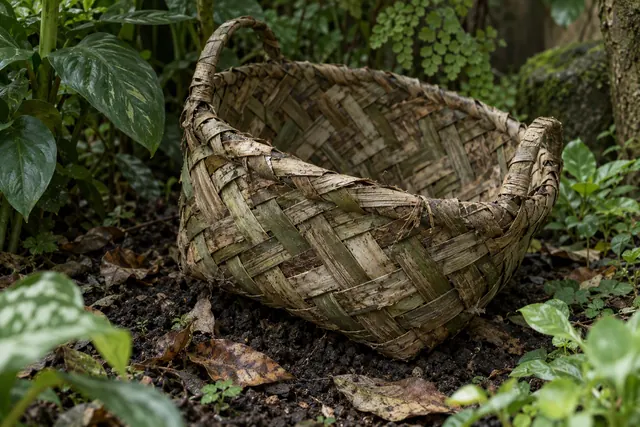
The landfill problem
Here is the part that surprises people. A natural material does not automatically biodegrade well just because it is natural; the environment has to cooperate. In a sealed landfill, there is little oxygen and little moisture, so even a plain leaf can sit largely intact for years. Worse, when organic material does break down in that oxygen-starved setting, it produces methane, a potent greenhouse gas. Composting, which is aerobic, does not have that problem, which is why the destination matters as much as the material. The same basket is a benefit in a garden and a small liability in a sealed bin.
A leaf craft is only as compostable as the conditions you give it. The material is not the whole story; the destination matters just as much. Composting is a choice you make on the piece's last day, not a property it carries from the start.
Romen Roy
How to compost a finished piece
Composting a Leaf Craft
-
1
Remove non-compostable parts
Cut away any synthetic thread, glue, staples, wire or plastic trim. If the piece cannot be separated, it is not compostable as a whole, and it belongs in general waste.
-
2
Break it into pieces
Cut or tear the weave into sections of 10 cm or less. Smaller pieces expose more surface area to microbes and break down far faster than a whole basket.
-
3
Add it to the heap
Mix the leaf pieces with green material such as grass clippings and brown material such as dry leaves or cardboard, aiming for roughly equal volumes. The brown material keeps the heap from going slimy.
-
4
Keep it moist and turned
Aim for the moisture of a wrung-out sponge and turn the heap every week or two so oxygen reaches the middle, where the leaf pieces sit.
-
5
Check before spreading
After three to six months, look for a crumbly, earthy texture with no recognisable weave left. Only then spread it on beds, so it does not rob the soil of nitrogen.
Made to return to the soil
Our plain woven pieces are untreated and thread-free, so they compost cleanly.