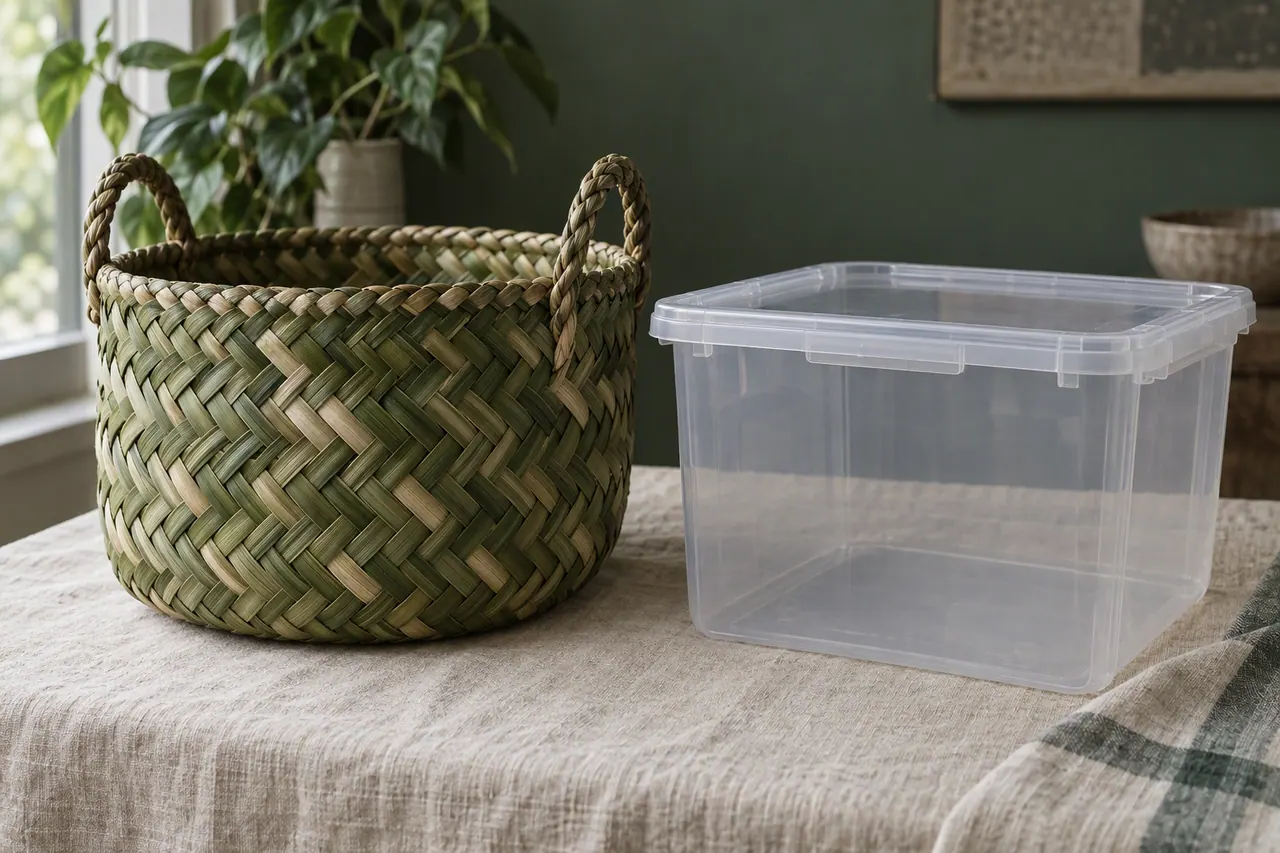

In short
An honest comparison of palm leaf and plastic homeware: lifespan, water resistance, cost, hygiene and end of life, including the cases where plastic genuinely wins.
It would be easy to write a piece saying palm leaf is good and plastic is bad. It would also be wrong often enough to be useless. This is the version I would want to read before buying: where each material actually wins, and where the popular story falls apart under scrutiny. If you finish it and still buy plastic for some jobs, that is a good outcome.
I make and sell woven palm leaf objects, so treat my bias as a known quantity. The comparison below tries to be fair anyway, because a recommendation you cannot trust is worth nothing, and because the honest cases are the only ones that stick. If the conclusion is that plastic is sometimes the right material, that is a feature of the article, not a flaw.
The first honest point is that plastic is an extraordinary material. It is cheap, waterproof, hygienic, uniform and durable. Those are the reasons it replaced woven baskets in the first place, and pretending otherwise does not help anyone choose well. The real question is narrower: for a given job in a given home, which material does it better, and what does each one cost the planet at the end? Answering that properly means admitting that both columns of the table below have entries. The interesting work is in the trade-offs, not in declaring a winner.
Head to head
| Factor | Palm leaf | Plastic |
|---|---|---|
| Lifespan, daily use | 1 to 3 years | 5 to 20 years |
| Water resistance | Poor; warps and moulds if left damp | Excellent |
| Consistency | Variable; each piece differs | Highly uniform |
| Upfront cost | GBP 15 to 40 for a basket | GBP 2 to 10 |
| Repair | Possible by hand | Rarely; usually replaced |
| Feel and warmth | Warm, textured, natural | Neutral, smooth |
| End of life | Composts in 3 to 12 months | Persists for centuries |
| Food contact | Suited to dry goods | Suited to wet and greasy |
Read down that table and a clear picture emerges. Palm leaf wins on feel, repair and end of life. Plastic wins on lifespan, water resistance, consistency and cost. Neither column is empty, and that is the whole point. Anyone who tells you one material is simply better has either not used the other, or is selling something. The next section is the one most articles skip entirely. It is also the one that decides whether you trust the rest of the comparison.
The downsides of natural materials, stated plainly
- Shorter lifespan. A woven basket used daily for groceries will start to look tired within a year and may need re-weaving within three, against a decade or more for a plastic tub.
- Water sensitivity. Wet produce left in a leaf basket overnight can leave stains and, in humid climates, mould. Woven pieces must be allowed to dry fully after every use.
- Variability. Two baskets from the same maker will differ in colour, weave density and weight. Some buyers love this; others want uniformity and are disappointed.
- Higher upfront cost. Handwork is expensive. A palm leaf basket costs several times a plastic tub of similar size, and the gap never fully closes.
- Less hygienic for raw meat. An open weave cannot be wiped clean the way a sealed plastic surface can, which matters for anything raw or greasy.
- Requires active care. A plastic tub can be ignored for a year; a woven basket needs drying, dusting and occasional repair to survive that long.
Do not use an open woven basket for raw meat, fish or anything that leaks. The weave traps moisture and cannot be sanitised properly, so use a sealed container and keep the basket for dry goods. This is one of the clearest cases where plastic is simply the correct material.
The honest case for plastic
There are real jobs where plastic is simply better and choosing leaf is a mistake. A lunchbox that sits in a damp bag all day needs a watertight seal. A container for cleaning chemicals needs to be inert and wipeable. A storage box in a damp garage needs to resist mould. In each of these, a natural alternative would fail faster, need replacing more often, and end up costing more both in money and in material. Choosing leaf here is not a virtue; it is a mistake dressed as one. The green choice and the right choice are not always the same thing, and pretending otherwise undermines the whole argument. The honest position is more useful and, in the long run, more persuasive.
The strongest argument against plastic is not that it is worse at these jobs. It is that it lasts so long that it outstays its usefulness by centuries, and that is a problem no amount of good service in the first ten years can excuse. A material can be excellent at its job and still be the wrong thing to make in the quantities we make it.
Romen Roy
How to decide
A Simple Decision Rule
- Dry and decorative: choose palm leaf; it looks better, feels warmer and composts cleanly.
- Wet, greasy or raw: choose a sealed container, whatever it is made from, without guilt.
- Long storage in a damp space: plastic is the honest choice, and natural fibre will only disappoint you.
- Everyday carrying: pick whichever you will actually repair and keep, because a discarded object helps no one. The greenest object is the one still in use.
Where leaf genuinely fits
Our woven pieces are made for dry goods and everyday display, and we say so plainly.